Voice Practice

A Field Guide to Practice

In preparing for the fourth and final session of Voice as Practice, I found myself jotting down a list of approaches that have been helpful in supporting our voice practices.

Instead of understanding our voices as something that needs fixing or control, what if we related to the voice as a place we can go to, an experience we can return to, something that naturally shifts and grows through continued interaction?

Our voice and our relationship to it can feel intense, even urgent at times. I don’t mean to minimize that in any way. But I’ve come to believe that the simple act of continuing to show up, of giving myself permission to make sounds (whether weird, uncomfortable, clear, or pleasant), has led to the most meaningful change, and a deeper connection with myself.

So, here’s the list I created, which I’m calling A Field Guide to Practice. I hope it supports you! Leave me a comment if you have any thoughts or questions :)


A Field Guide to Practice

This is a field guide. These are not rules. 
They’re ways of protecting the container so that change can take its course. 

Change is the only constant, and continuing to show up will eventually, naturally, yield to change. 
Learning to enjoy and nurture our practice supports our continued attempts to show up.

Your (only) job is to show up.

Treat it like a yoga class.

  • No expectation of mastery

  • Spending the whole class in Child’s Pose is valid, even encouraged

    • What is Child’s pose in Voice Practice?
      this could be… feeling your pulse, counting your breath, softening/widening your gaze, humming gently out loud or in your imagined voice

  • Accept our different body/voice types, and let go of the need to compare

  • Walking away and taking breaks is part of the practice

Ritualize it.

Make practice inevitable.

  • Leverage habit science (one of my favorite writers/thinkers on this topic is James Clear)

  • Encourage repetition

    • Doing the same thing is good

    • Developing a “launch sequence” for your voice practice so it becomes automatic

  • Embrace spirituality

  • Savor it

    • Make it special.

    • Treat small things with reverence. 

Small chunks.

Respond to overwhelm not as failure, but as a sign to downsize.

  • Focus on just one thing to work on

  • Set a timer and practice for just 5 minutes

  • Break down a song into more tangible pieces

    • Choose a 5~10 second chunk to sing/listen/speak

    • Hum just the pitches without the words

    • Speak just the words without the pitches

Leverage the body and nervous system.

Protect the container through self-regulation.

  • Incorporate somatic practices (somatic = relating to the body, distinct from the mind) & grounding techniques

    • 5-4-3-2-1 grounding

    • Widening your gaze

    • Humming (stimulates the vagus nerve!)

Be curious, not corrective.

Assume you and your body are responding intelligently.

  • Begin to let go of the need to fix

  • Descriptive feedback > prescriptive feedback

    • Prescriptive feedback often sneaks in wearing the disguise of helpfulness. If it sounds like a command or a correction, it’s probably prescriptive

  • Be nice. Say only things you’re also comfortable saying to a dear friend

Be an explorer. Or a scientist!

Invite playfulness and strangeness.

  • Pick a song you ‘don’t care about’ and try imitating the singer just for fun

  • Watching videos of vocal anatomy.

  • Experimenting with extended technique (overtones, suboctaves, multiphonics).

  • Get weird. Make yourself laugh. 

Track and reflect.

Make change visible.

  • Create tangible ways to track progress

  • Keep a practice journal

  • Use practice aids

    • Timers, tuners, spectrographs
      My favorite practice apps: Spectrolite, Tonal Energy TE Tuner, Voice Tools, dB Meter

Let practice leak into life.

  • Hum in a public space

  • Beyond your voice practice, expand awareness of how you use your voice in your day-to-day life

  • Use your supportive mindset around your voice beyond yourself

    • Notice criticism of voices/creativity without need to fix

  • Wonder out loud


Voice as Practice is live!

For years, I’ve been dreaming of a space where people can explore their voices with curiosity, gentleness, and depth. A forum or platform that isn’t centered solely on technique and judgment, but on the whole experience of singing. I think this vision began back in music school: I wasn’t always a confident singer, but I had this steady conviction that I needed to sing. Too often, that desire felt dismissed because I didn’t have “proper technique.”

Last year, I created my first course, Practical Tips for Singing Better, and it shifted something in me. I discovered how much I enjoy teaching in a multi-week format. The real-time conversations, the shared breakthroughs, the feeling of everyone learning and exploring together… it was one of those projects that made me feel like I’d found a real purpose.

Ever since then, I’ve been slowly building toward something more thoughtful, more spacious, and more aligned with how I actually think about voice. And this month, I finally launched it: Voice as Practice, a four-week live course centered around the Three Domains of Singing; the Musician, the Instrument, and the Human.

I’m pasting the “Why I Created This” section from my sign-up page below if you’d like to read more about the intention behind the course.

If you’re interested in joining, or you want to learn more, you can find all the details here: courtneyswain.com/voice

Sign-ups are open through Friday, December 5th, and Early-bird pricing is available through Wednesday, November 26th!


Why I created Voice as Practice

When I first started studying voice, I often felt lost in the very environment that was supposed to support me. I loved singing… I felt like I had a voice, and I needed to use it. But the instruction and feedback I received in school often left me feeling small, confused, and disconnected from my own sound.

Over the years, through trial and error, singing night after night on tour, teaching, and improvising, I slowly learned a different way to approach my voice. One that honors both the instrument and the human. One that centers ease, curiosity, and self-awareness. One that understands that confidence and creativity don’t come from being critiqued into perfection, but from building a relationship with your voice that feels supportive and sustainable.

I created this course because I wish I’d had something like it back then. A space where technique isn’t divorced from humanity, where exploration is encouraged, and where feedback is useful, actionable, and kind. It feels like singers are expected to figure out their confidence and identity by themselves, often without the tools or encouragement they actually need. I wanted a place where those parts of singing are supported, coached, and nurtured; not left to chance.

My hope is that this course gives you the tools and the permission to meet your voice with more care, curiosity, and trust than you may have been taught to. And that over these four weeks, you begin building a practice that supports you for the long term, no matter how or why you sing.

a softer way to sing 🪽

Over the past few days, nearly 90 of you have taken my Voice Self-Assessment Quiz, and reading your reflections has been incredible!

One of the biggest themes I noticed was that many people feel much less supported in the Instrument and Human domains of singing compared to the Musician domain. And only one person said they feel confident addressing something in their voice when they notice it 🥲

I wanted to make something in response to that.

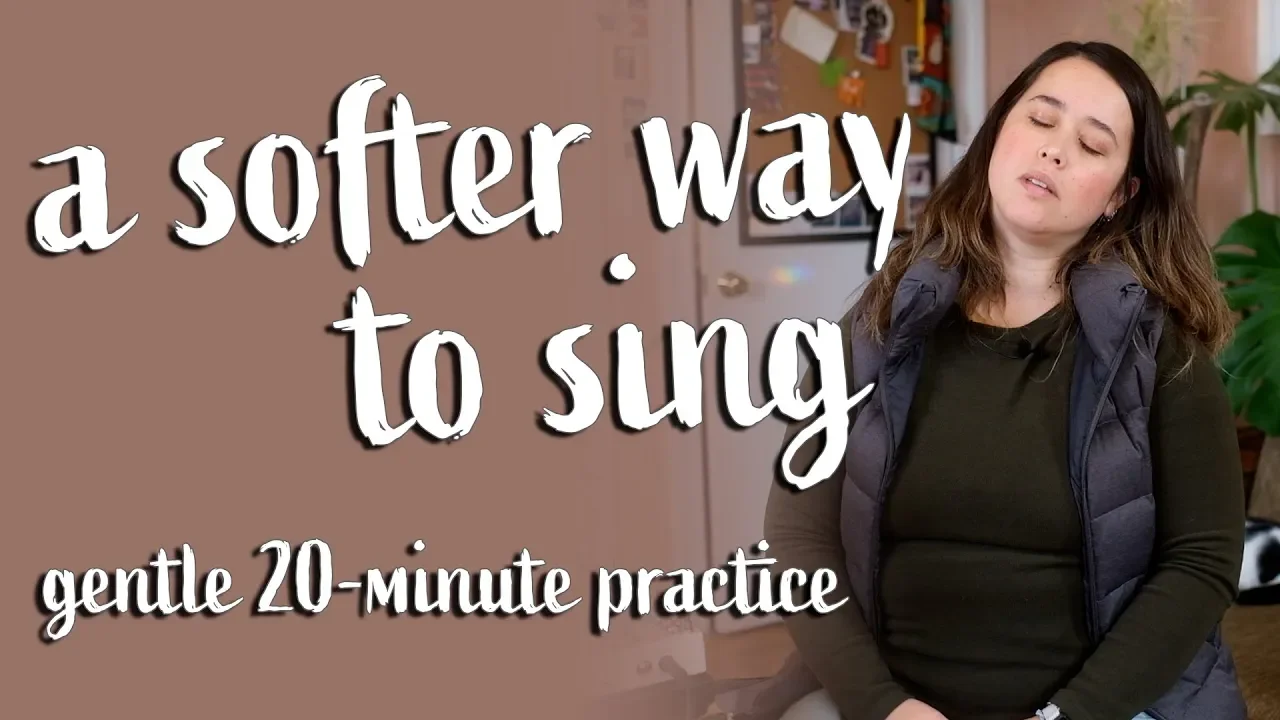
So here’s a gentle 20-minute voice awareness practice.
It’s something you can use to build body awareness, soften your mindset, and reconnect with your voice without pressure or judgment. There’s stretching, grounding your nervous system, humming, and an exploration of the phrase “this is my voice,” which is a simple but powerful way to notice how your body and your mind respond to sound.
👉 You can watch the full practice here

If you haven’t tried my self-assessment quiz yet, you can find it below ⬇️

🔮 Take the Self-Assessment Quiz